The Second Commandment, The Trinity and The Omnipresence of God
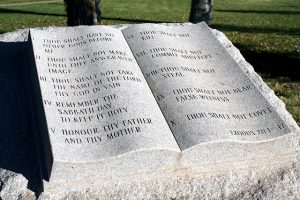
I always wondered what was so significant about the second Commandment that Rome found it necessary to remove it altogether from the Ten Commandments. But it appears that there is a fundamental truth in that Commandment concerning where God’s presence is that is intended to protect us from all forms of false worship.
The second Commandment tells us that we should not bow down before any image. This implies that God is not in any image. Which means that God is not everywhere. The Bible tells us that God is in heaven; and heaven is not everywhere. Heaven is above the earth and that is where we should direct our worship to God, where He is. He knows everything that happens everywhere and can go wherever He pleases but His abode is in heaven where Jesus, our High Priest and intercessor, is presenting our cases to Him. – “Now of the things which we have spoken this is the sum: We have such an high priest, who is set on the right hand of the throne of the Majesty in the heavens” (Heb. 8:1).
Worshipping God Where He Is
Furthermore, both the prophets Daniel and John saw God in heaven with the angels gathered around His throne and Jesus being separate and distinct (Dan. 7 and Rev. 4, 5). Daniel said “the Ancient of days did sit” (Dan. 7:9) and “one like the Son of man came with the clouds of heaven, and came to the Ancient of days” (Dan. 7:13). John said “one sat on the throne” (Rev. 4:2) who was worshipped as the Creator to whom it was said “Thou art worthy, O Lord, to receive glory and honour and power: for thou hast created all things, and for thy pleasure they are and were created” (Rev. 4:11), with Jesus appearing before Him to receive a book and power and authority, as the Lamb who was slain, while the angels sang, “Blessing, and honour, and glory, and power, be unto him that sitteth upon the throne, and unto the Lamb for ever and ever.” (Rev. 5:13).
God is not everywhere all at once like a vapour while part of Him or an image sits on the throne representing Him. God Himself sits, of whom man was made in His image after His likeness, “made after the similitude of God” (James 3:9).
Logically, if God is everywhere, He can be worshipped wherever He is. One could then bow down and worship before a stone, a tree, a person or any object, not as worshipping the object but as worshipping God, since God is in it. That would open the door for the worship of false Gods as no one would be able to tell the difference whether you are worshipping the true God or not.
It would not be consistent to forbid worshipping before an object if God is in the object and one is worshipping, not the object, but God who is in the object. This is evident in the experience of the children of Israel in the wilderness. God appeared to them in a cloud and they were not forbidden to bow before Him in the cloud – “And the LORD said unto Moses, Lo, I come unto thee in a thick cloud” (Ex. 19:9), “And all the people saw the cloudy pillar stand at the tabernacle door: and all the people rose up and worshipped, every man in his tent door” (Ex. 33:10). If God is not in a particular place, say in an image, it means that there is at least one place where He is not. He cannot be everywhere and not everywhere at the same time.
The idea that the Holy Spirit is God present everywhere was precisely the argument that Dr. John Harvey Kellogg put forward to justify his pantheistic teachings. And Ellen White told him that he was wrong. Initially, he said that God was in everything. And when God instructed Ellen White to oppose it, he modified it by saying that at the time of his first presentation of the matter in the book “The Living Temple” he did not believe in the Trinity. Because of that, he said he had not given a clear explanation of the matter. He went on to explain that he had now come to believe in the Trinity and could better explain his idea. The new explanation was that it was not God the Father, but God the Holy Ghost who was everywhere and in everything. Ellen White told him that he was wrong. And we can see why. If God the Holy Spirit is everywhere and can be worshipped, it is a doorway to replace worshipping God and Christ in heaven entirely.
Another modified version of Kellogg’s idea is that the Holy Spirit is really Christ himself or both God and Christ in an omnipresent form. This is also not correct as it places God and Christ on earth rather than in heaven.
Omnipresent Representative
The pioneers of Seventh-day Adventism stated in their Fundamental Principles of faith published in the 1889 Yearbook that God was everywhere present by His representative, the Holy Spirit. At face value, this would suggest that this representative is omnipresent. But it is perhaps more consistent with scripture to say that He is everywhere present by His representatives the holy spirits. Holy spirits are ministering spirits sent from heaven – “And he saith unto him, Verily, verily, I say unto you, Hereafter ye shall see heaven open, and the angels of God ascending and descending upon the Son of man.” (John1:51). “Are they not all ministering spirits, sent forth to minister for them who shall be heirs of salvation?” (Heb. 1:14). The prophet Zechariah also saw chariots that were sent into the different parts of the earth; and when he asked “What are these”, the answer given was that “These are the four spirits of the heavens, which go forth from standing before the Lord of all the earth” (Zech. 6:4, 5). This again, shows that spirits are sent by God into all the earth, and that these spirits are not God Himself.
This is consistent with the Hebrew word ruach and the Greek word pneuma that are translated in the Bible as spirit. These words are also translated spirits, thus indicating that the Holy Spirit need not be seen as one individual being who is omnipresent but many spirit beings representing God everywhere.
From this perspective, there is no denying that the Comforter, the Holy Spirit, sent at Pentecost is a person – only not a God-being to be worshipped. Like the Angel of Revelation 18 who comes down from heaven with the latter rain – a similar occurrence as that which took place at Pentecost except more extensive – the Comforter would be seen as a messenger sent by Christ from heaven, as stated repeatedly in John 14-16. Ellen G. White describing the latter rain speaks of a mighty angel from heaven being sent to do this work and further said, “Angels were sent to aid the mighty angel from heaven” (Ellen. G. White, Story of Redemption, p. 399).
Correcting Error
Some persons have objected by saying that Ellen G. White sought to correct one Brother Chapman who was saying that the Holy Spirit could be an angel. To be more accurate, Brother Chapman, according to a letter that Ellen G. White wrote to him, was teaching that the Holy Spirit is the angel Gabriel. Ellen G. White told him that his view was speculative and unscriptural. Indeed, the Bible does not teach that; and neither is that view being advanced here. She admonished him to come into harmony with his brethren on the matter and not seek to bring in any new idea regarding that subject. This was in 1891, when the stated belief of the church, as presented in the 1889 Seventh-day Adventist Yearbook, was that the Holy Spirit was God’s representative. This was before Kellogg sought to bring in errors concerning the Holy Spirit and the personality of God that she later had to refute.
At that time, when she wrote to Brother Chapman, she said “silence is golden” and indeed it would have been “golden” to remain silent on the matter of who or what is the Holy Spirit, at that time, but certainly not later when clearly erroneous views were being pressed upon the church regarding the matter. It certainly would not be “golden” now, either, to remain silent when the Trinitarian view, which the pioneers rejected, is now being actively promoted within the church and many who profess to reject the Trinitarian view are promoting virtually the same thing that Kellogg was trying to introduce into the church. Here is a sample of what Kellogg was saying:
“God the Father sits upon his throne in heaven where God the Son is also; while God’s life, or Spirit or presence is the all-pervading power which is carrying out the will of God in all the universe” (Letter from JH Kellogg to GI Butler dated October 25, 1903).
“The question may arise in the mind of some one, How do we know that God is in us? We are perhaps too prone to think of God as in heaven, or in some definite place, and only omnipresent in an accommodated or figurative sense. Let us ask the question, “Where is God?” – (Presentation “God in Man” made by JH Kellogg at the 32nd Session of the General Conference of Seventh-day Adventists on Feb. 15, 1897 at Lincoln, Nebraska and published in the General Conference Daily Bulletin of Feb. 18, 1897, Vol. 7. – No. 5).
The popular view that has been embraced by many who have rightly rejected the Trinity, has unfortunately been tainted by this popular error that is common among professed Christians, New Agers and pagans alike – the error that God is personally present inside people – one that was plainly rejected by the Seventh-day Adventist pioneers. The pioneer, James White, even wrote an article responding to the claim that God is everywhere, by saying that “God is everywhere by virtue of his omniscience” and that “God is in heaven”; further, “if God is as much in every place as he is in any one place, then heaven is also as much in every place as it is in any one place, and the idea of going to heaven is all a mistake. We are all in heaven; and the Lord’s prayer, according to this foggy theology simply means, Our Father which art everywhere, hallowed be thy name. Thy kingdom come, thy will be done, on earth, as it is everywhere”.
Holy Spirit and Blasphemy
It should be noted that Jesus’s warning against blaspheming against the Holy Spirit is not implying that the Holy Spirit is more to be revered than Jesus Himself since one will not be forgiven if they speak against the Holy Spirit whereas they can be forgiven if they speak against the Son (Matt. 12:31, 32). Jesus went back to heaven and promises to return to this earth to take us to His Father’s house in heaven. He left the Holy Spirit to guide us until He returns. If we reject that guidance by blaspheming against the Holy Spirit, there will be nobody to guide us. The situation is like what God told the children of Israel in the wilderness – “Behold, I send an Angel before thee, to keep thee in the way, and to bring thee into the place which I have prepared. Beware of him, and obey his voice, provoke him not; for he will not pardon your transgressions: for my name is in him.” (Ex. 23:20, 21). It is simply warning us not to reject the Holy Spirit’s guidance. It is not forbidding us seeking to understand who the Holy Spirit is or what the Holy Spirit does.
It should be noted that the word “spirit” has different meanings, so the understanding of the expression depends on the context. It could refer to God Himself, to Christ or to angels as spirit beings, or to the inner spirit or mind of the person, depending on the context. So, there is a sense in which Christ is in us, meaning that His mind is in us through His words, thoughts and character. No one should therefore think that the spirit of Christ that dwells in us is an angel or Christ Himself or God in person.
Alpha and Omega of Deadly Heresies
So, there we have it. The church has now fully accepted Kellogg’s idea. Ellen White said that the initial presentation by Kellogg was the alpha of deadly heresies. She said that the omega would follow shortly afterwards and would be accepted. And it did follow shortly afterwards in Kellogg’s modified version, based on his acceptance of the Trinity. And the church has now fully accepted it – that God (the Holy Spirit) is everywhere and should be worshipped. So, based on current practice, Jesus is worshipped, the Holy Spirit is worshipped but the One true God is almost entirely ignored. Jesus, praying to His Father, made it clear who the “only true God” is and identified Himself as the one sent by God – “And this is life eternal, that they might know thee the only true God, and Jesus Christ, whom thou hast sent.” (John 17:3).
Nowhere in the Bible is worship given to anyone else except the one seated on the throne who is referred to as “LORD God Almighty, which was, and is, and is to come” (Rev.4:8) and to Christ, the Lamb, as it will be in the new earth – “And I saw no temple therein: for the Lord God Almighty and the Lamb are the temple of it.” (Rev. 21:22). God is the Father of Christ. Accordingly, Christ, the Lamb is seen with “an hundred forty and four thousand, having his Father’s name written in their foreheads” (Rev. 14:1). It is the name of the Lamb’s Father that will be written in their foreheads.
Whatever one’s concept of the Godhead, the term “godhead” is used only three times in the Bible (Acts 17:29, Rom. 1:20 and Col. 2:9) and in none of these places is the expression used to replace the idea of God being a single individual who has a Divine Son who is worshipped alongside Himself. And not even once does the term “godhead” in scripture allude to the worship of anyone else.
All worship should be directed to God and Christ in heaven. It is not about where we are when we worship but, like sending a petition to the king of England, we do not send it to Spain or Australia but to him in England where he is. Similarly, Jesus in teaching us how to pray directed that we say, “Our Father which art in heaven”.
We should not be praying to nor worshipping anything on earth. We should pray to God in heaven, approaching His throne through Christ, our Mediator, and we should direct our worship to heaven where God is. This is the substance of the second Commandment that Rome has removed.
“He that hath ears to hear, let him hear” (Matt. 11:15).
For further information, please visit Patience of the Saints at http://thecommandmentsofgodandthefaithofjesus.com/
Questions and comments may be sent by e-mail to: commandmentsofgodandfaithofjesus@yahoo.com